Keep control visible
Connect controllers, recovery terms, and every approved state change to one named Bitcoin agreement.
Drops Pacts

Agreements can be serious. Their interface does not have to be beige. Pacts makes the terms, state, and verification route visible before parties act, using Bitcoin UTXOs and a bounded validation model rather than an opaque virtual machine.

Built for clear commitments
Use the same visible-first approach for a token policy, release schedule, shared treasury, or escrow flow. Pacts keeps the agreement identity and stated transition path inspectable, so the people involved can distinguish what Bitcoin directly enforces from what a Pact validator verifies.
Connect controllers, recovery terms, and every approved state change to one named Bitcoin agreement.
Make the release and refund route clear before value moves, then follow the agreement history on Bitcoin.
Give beneficiaries and teams a reviewable release plan that is tied to Bitcoin block height.
Pair an op-drop policy with a readable agreement record that people can inspect independently.
Move from the immutable agreement identity to a confirmed state change with a compact proof pack.
Pacts never asks for seed phrases or private keys. Your wallet creates and signs the Bitcoin transaction.
The smart-agreement boundary
Pacts is deliberately not an EVM or WASM runtime. The model is compact enough to audit: a Seed fixes the agreement identity, a live Cell holds the current commitment, and a proof package explains an accepted successor state.
Bitcoin consensus confirms a Cell can only be spent once and validates the key-path or declared recovery conditions that its transaction uses.
A compatible validator replays the declared rule family, verifies the Proof Pack, and checks that the successor Cell matches the committed DPC1 transition. It never silently turns an outside spend into a valid successor state.
Fix the agreement identity, rules, and initial state commitment.
Commit the current visible state in a normal Bitcoin UTXO.
Verify the transition and its confirmed successor state.
The Pacts lifecycle
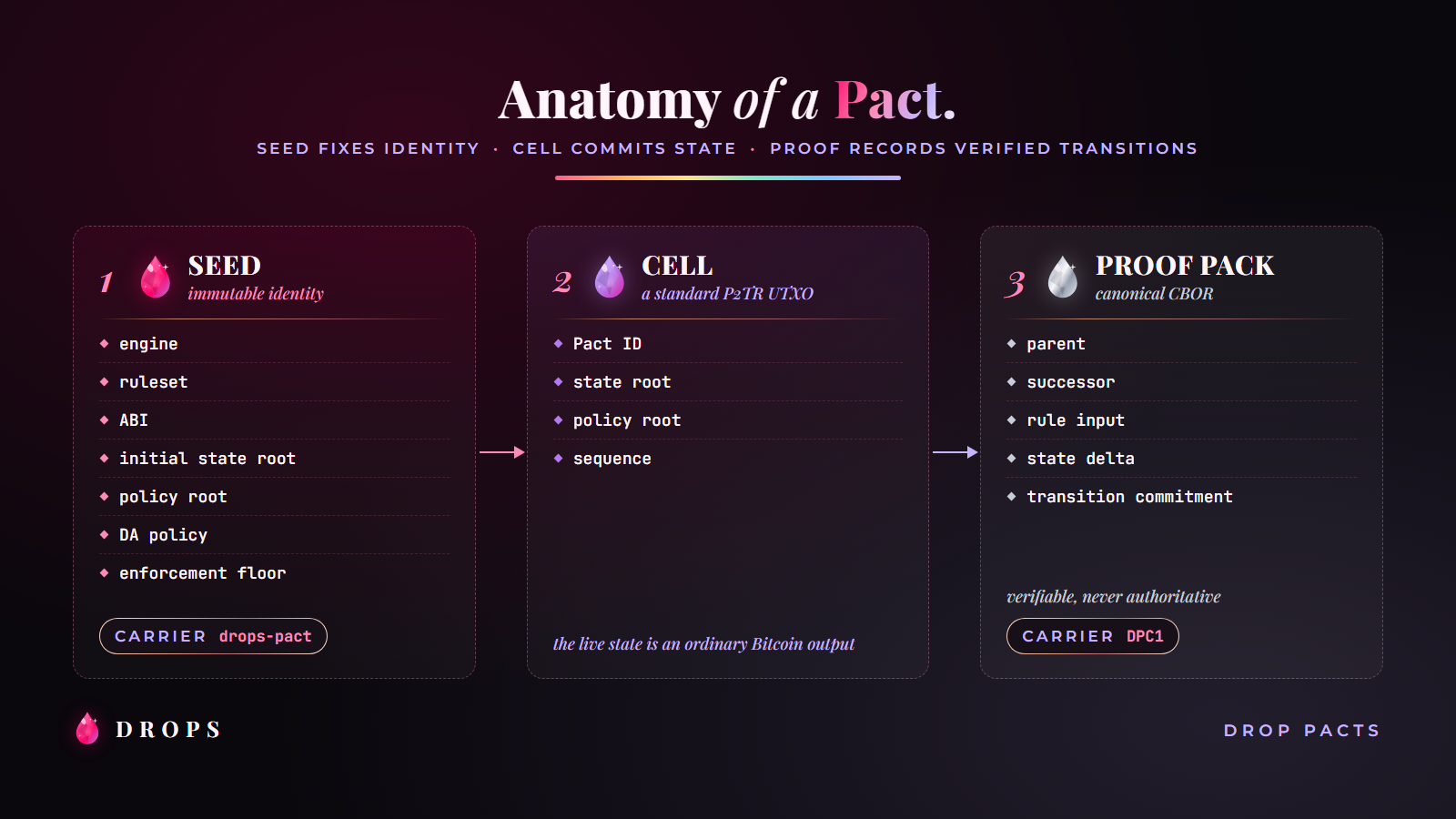
The Pact Seed gives the agreement a stable Bitcoin identity. A live Cell commits its current state. A normal update creates a successor Cell and a compact DPC1 transaction commitment, with a canonical Proof Pack to verify the move.
Pact anatomy
Each building block has a narrow job. That makes an agreement easier to review, easier to index, and easier to explain to the humans who will live with its outcome.
An immutable compact record commits to the engine, ruleset, ABI, initial state root, policy root, data availability policy, and enforcement floor.
A P2TR UTXO holds the Pact ID, state root, policy root, and sequence in a verifiable descriptor commitment.
Canonical CBOR data proves the parent, successor, rule input, state delta, and the confirmed transition commitment without becoming an authority itself.
Pact anatomy
Seed, Cell, and Proof Pack each have a narrow role. That keeps the agreement record readable for people and concrete enough for an independent validator to verify.
Bitcoin L1 agreement design
Pacts works with Bitcoin UTXOs, signatures, timelocks, and transaction structure. The enforcement grade stays visible so signers can distinguish a Bitcoin-enforced condition from an independent Pact-validation conclusion.